
For decades, safety-critical engineering has treated the safety case as a milestone artifact.
A team designs a system, performs hazard analysis, allocates requirements, executes verification, assembles evidence, and produces a document that argues the system is acceptably safe for operation.
That model made sense when systems changed slowly.
It breaks under modern autonomy.
Today’s robotics and AI systems evolve continuously:
- OTA software updates
- retrained perception models
- changing operational design domains
- supplier firmware updates
- simulation-driven iteration
- rapidly expanding edge-case libraries
- fleet-learned behavioral improvements
The deployed system no longer stands still long enough for a static safety argument to remain accurate.
Yet much of industry still treats safety as if it were a snapshot.
That disconnect is becoming one of the defining engineering problems of embodied AI.
## The Safety Case Was Never Really a Document
The traditional safety case is typically represented as:
- PDFs
- spreadsheets
- traceability matrices
- static review packages
- manually assembled evidence binders
But those artifacts were always shadows of something deeper:
the relationships between engineering intent, implementation, assumptions, and evidence.
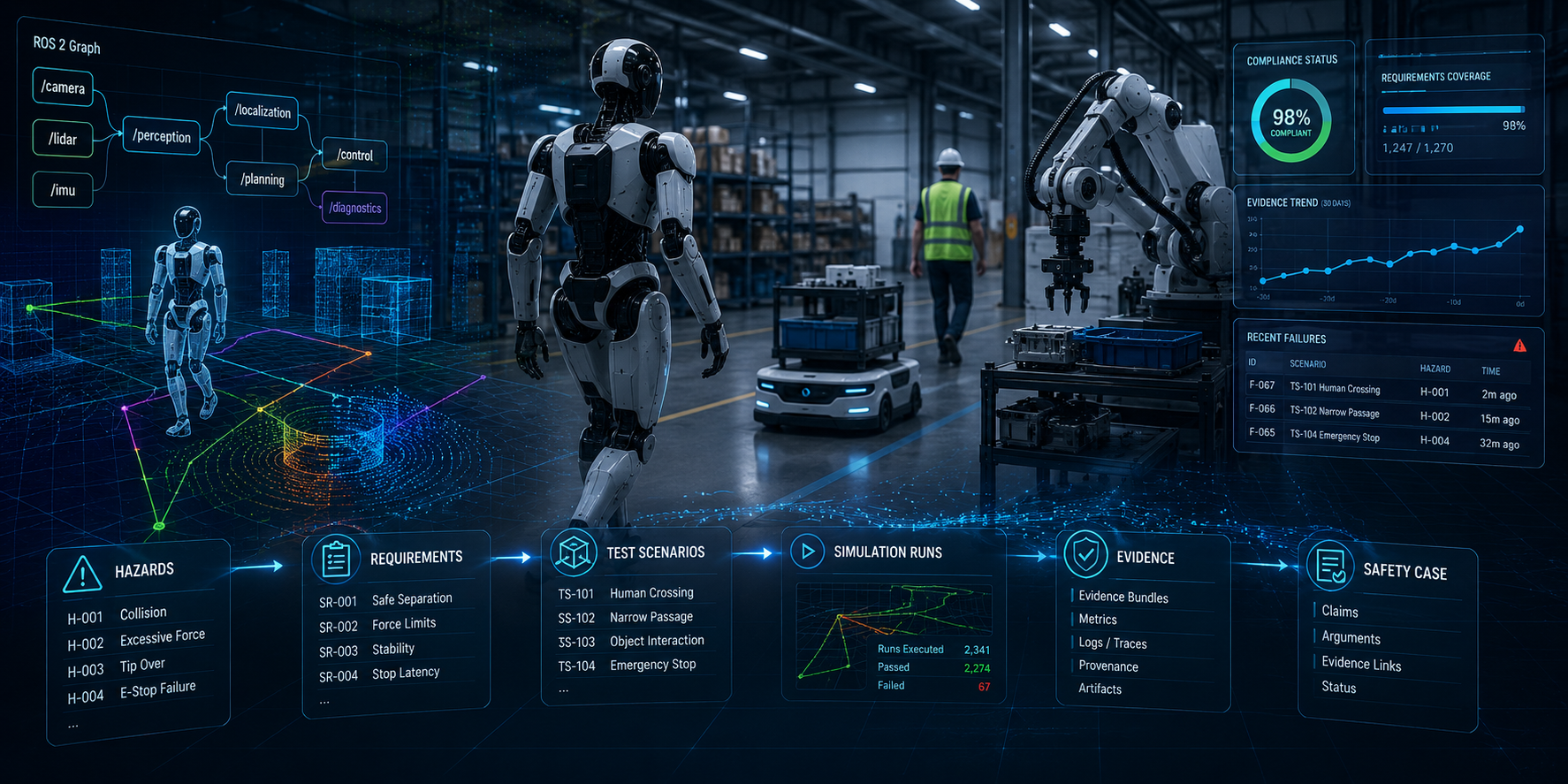
A hazard links to:
- a safety goal
- technical safety requirements
- implementation logic
- simulation scenarios
- tests
- operational assumptions
- verification evidence
- reviewer approvals
The real system is not the document.
The real system is the graph.
The document is merely a rendering of that graph at a point in time.
This distinction matters enormously once systems begin changing continuously.
## Modern Autonomy Broke the Snapshot Model
Traditional safety workflows assume:
1. Requirements stabilize
2. Architecture stabilizes
3. Verification executes
4. Safety case is assembled
5. Product ships
Modern autonomy systems do not behave this way.
Instead:
- perception stacks evolve weekly
- fleet telemetry surfaces new edge cases
- simulation catalogs expand continuously
- software updates invalidate prior assumptions
- cybersecurity vulnerabilities trigger design changes
- operational constraints shift after deployment
The result is that many safety cases begin drifting from reality almost immediately after approval.
This creates a dangerous engineering condition:
a system whose operational behavior evolves faster than its assurance structure.
The problem is not lack of standards expertise.
The problem is stale relationships.
## Most Safety Failures Under Change Are Graph Failures
In practice, many critical failures emerge not because a hazard was never identified, but because a change failed to propagate through the engineering system.
A software timing change may invalidate:
- latency assumptions
- braking-distance analyses
- sensor synchronization guarantees
- verification evidence
- safety margins
- safety arguments
But today, these relationships are often maintained manually across disconnected tools:
- DOORS
- Jira
- Polarion
- Excel
- simulation systems
- test infrastructure
- architecture models
- ticketing systems
Each tool manages individual nodes.
Nobody manages the graph.
The burden of propagation falls onto human memory and organizational process.
That does not scale to continuously evolving autonomous systems.
## The Future Is the Living Safety Case
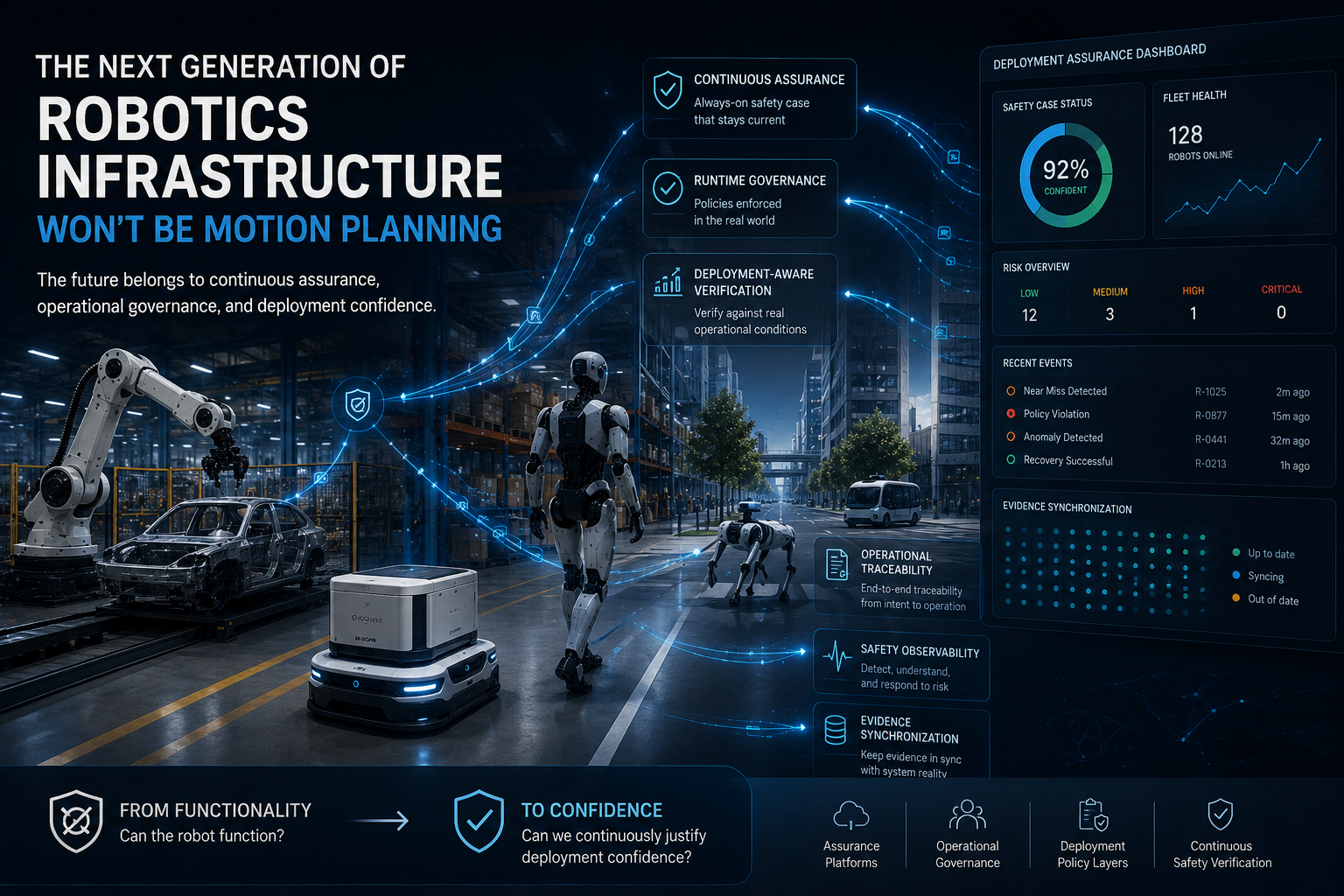
The next generation of safety infrastructure will treat the safety case not as a static deliverable, but as continuously re-derived system state.
A living safety case continuously synchronizes:
- requirements
- architecture
- hazards
- controls
- code
- tests
- simulations
- operational assumptions
- deployment evidence
- runtime incidents
When something changes:
- affected assumptions are identified
- stale evidence is surfaced
- impacted verification is flagged
- downstream safety arguments are invalidated or regenerated
- engineers review and approve proposed updates
The important shift is conceptual:
the safety case stops being an artifact assembled before audit.
Instead, it becomes a continuously maintained operational model of system assurance.
## Safety Needs Its CI/CD Moment
Software engineering already went through this transition.
Years ago, software releases were:
- infrequent
- manually assembled
- difficult to reproduce
- operationally risky
Modern software infrastructure evolved toward:
- CI/CD pipelines
- automated dependency management
- reproducible builds
- observability
- continuous testing
- deployment automation
Safety-critical engineering is now approaching a similar inflection point.
The challenge is not merely generating documents faster.
The challenge is maintaining assurance integrity under continuous change.
This requires:
- change-aware traceability
- graph-based dependency management
- continuous verification linkage
- evidence freshness monitoring
- approval workflows
- runtime observability
- operational assurance infrastructure
In other words:
Safety DevOps.
## The Safety Engineer Does Not Disappear
A common misconception is that AI-driven safety tooling attempts to automate engineering judgment.
Credible systems should not do this.
The future is not autonomous sign-off.
The future is operational amplification.
The role of the system is to:
- surface propagation impacts
- identify stale assumptions
- draft traceability updates
- maintain evidence linkage
- highlight verification gaps
- preserve reasoning structure
Qualified engineers still review, reject, override, and approve.
Correctness remains a property of the engineering process.
But the process itself becomes dramatically more scalable and resilient.
## Why This Matters for Embodied AI
Large language models created an explosion of interest in AI safety.
But physical AI introduces a different class of challenge entirely.
Embodied systems interact with:
- humans
- vehicles
- machinery
- infrastructure
- unpredictable environments
Failures have physical consequences.
As autonomy expands into:
- robotics
- industrial systems
- autonomous vehicles
- aerospace
- logistics
- humanoids
- defense systems
the bottleneck increasingly becomes operational assurance.
Not merely:
"Can the system function?"
But:
"Can we continuously maintain justified confidence in the system as it evolves?"
That is ultimately an infrastructure problem.
## The Next Decade of Safety Engineering
The long-term direction is becoming visible:
- safety cases become live graphs
- verification becomes continuously linked
- simulation integrates directly into assurance
- runtime telemetry feeds revalidation
- evidence freshness becomes observable
- deployment gates become policy-aware
- assurance becomes operational infrastructure
The organizations that adapt earliest will gain substantial advantages:
- faster iteration
- lower audit overhead
- reduced rework
- better operational visibility
- safer deployment velocity
- stronger regulator confidence
The static safety case is not disappearing because safety matters less.
It is disappearing because modern systems no longer stand still long enough for static assurance to remain valid.
The future belongs to living systems of assurance.