
As AI systems become increasingly central to safety-critical domains—automotive, robotics, and industrial autonomy—the question is no longer whether to apply safety standards, but how those standards translate into real engineering practice.
In a recent discussion with industry experts, we explored how guidance from ISO/PAS 8800 and ISO/IEC TS 22440 is actively influencing modern safety workflows, system architectures, and regulatory strategies.
The takeaway is clear:
These standards are not theoretical—they are actively reshaping how safety-critical AI systems are built, validated, and communicated.
1. From Standards to Structured Workflows
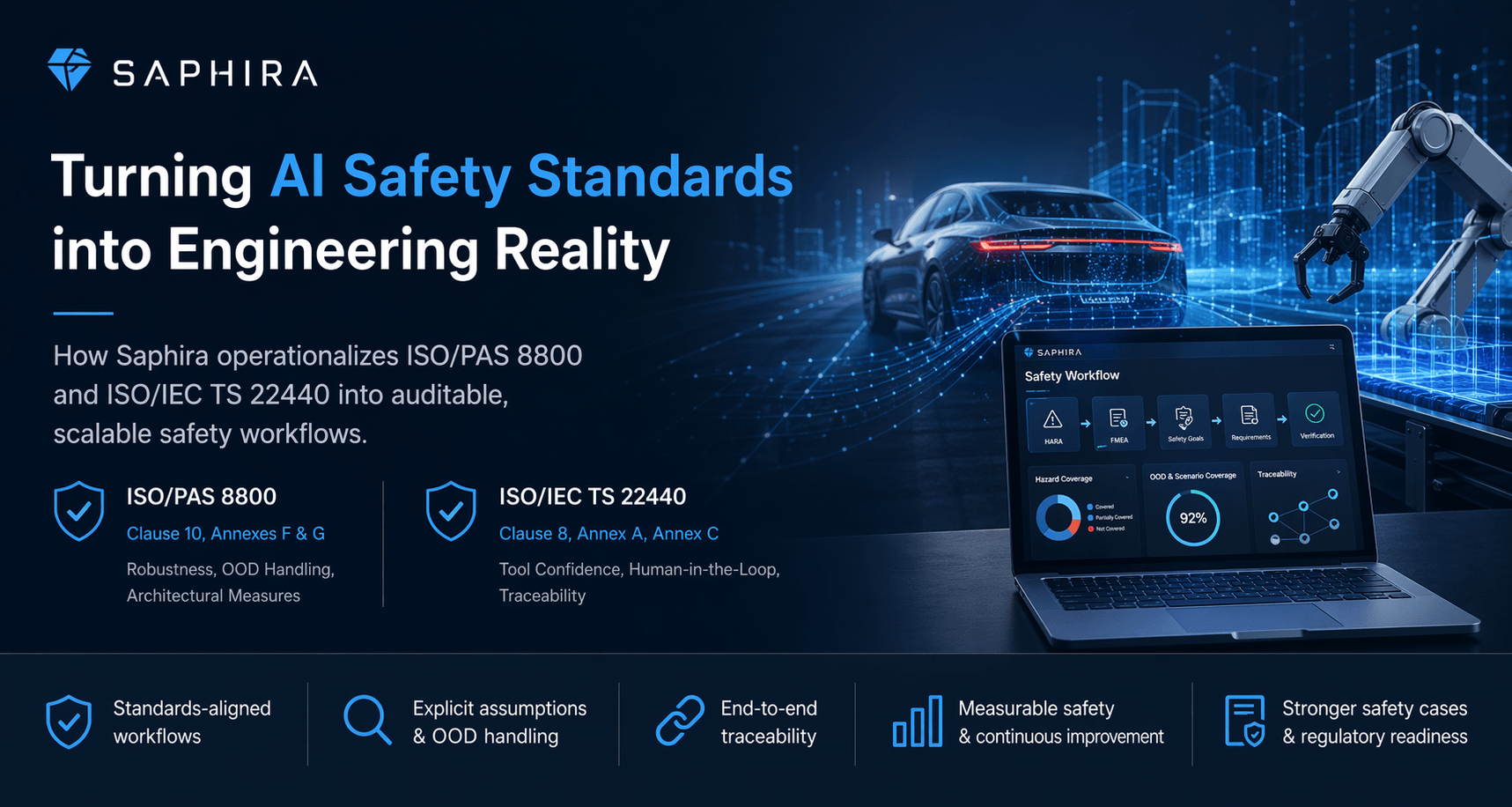
At Saphira, we don’t treat standards like ISO/PAS 8800 or ISO/IEC TS 22440 as standalone compliance checklists. Instead, we embed their principles directly into how safety workflows are structured and executed.
This includes:
- Human-in-the-loop approval gates for all safety-critical artefacts
- Full traceability across HARA, FMEA, and safety concepts
- Structured inputs and outputs, replacing ad hoc documentation
- Explicit handling of operational assumptions (ODD/OED)
This approach reflects core ideas from:
- ISO/IEC TS 22440 (Clause 8, Annex A, Annex C) — tool classification, error detection, and confidence in use
- ISO/PAS 8800 (Clause 10, Annexes F & G) — robustness, architectural measures, and handling of AI uncertainty
Rather than asking “Is AI allowed?”, the practical question becomes:
How do we constrain AI so that it operates within reviewable, auditable safety processes?
2. A Shift Toward Explicit Assumptions and OOD Awareness
One of the most significant impacts of ISO/PAS 8800—especially Clause 10 and Annexes F & G—is the emphasis on:
- Explicit system assumptions
- Operational design domain (ODD/OED) clarity
- Out-of-distribution (OOD) behavior
Historically, many of these elements were implicit. Today, they are becoming first-class engineering artefacts.
In practice, this means:
- Safety workflows now require clear documentation of system limits
- Teams systematically explore edge cases and OOD scenarios
- Perception systems are evaluated not just on accuracy, but on failure behavior outside training distribution
This is especially critical for:
- Autonomous vehicles
- Industrial robotics
- Perception-heavy systems
3. OOD Detection as a Safety and Audit Mechanism
A particularly important concept is out-of-distribution (OOD) detection.
In simple terms:
- In-distribution → scenarios the model was trained on
- Out-of-distribution → novel or unexpected inputs
OOD detection provides a mechanism to:
- Identify when the system is operating outside its known capabilities
- Trigger fallback or safe-state behavior
- Log events for audit and analysis
In real deployments, this has led to:
- Structured logging of interventions and edge cases
- Improved auditability of AI system behavior
- Use of OOD signals as a qualitative safety metric
In some cases, teams have reported significant reductions in incident rates (e.g., up to ~90%) through:
- Data collection during development
- Simulation-based testing and mitigation
- Iterative improvement cycles
These workflows align directly with the intent of ISO/PAS 8800.
4. Bridging AI Behavior to Safety Artefacts
A recurring challenge in AI safety is translating model behavior into:
- Hazards
- Safety goals
- Requirements
- Safety case evidence
Standards like ISO/PAS 8800 and TS 22440 are driving a shift toward:
- Systematic linkage between AI failure modes and hazard analysis
- Explicit reasoning about how uncertainty propagates into risk
- Stronger connections between:
- HARA
- FMEA
- Functional safety concepts
In practice, this results in:
- More consistent safety artefacts
- Earlier identification of gaps or missing mitigations
- Better alignment between engineering teams and assessors
5. Architectural Measures for Robustness
Annexes F and G of ISO/PAS 8800 emphasize architectural and development techniques for improving robustness.
These are already widely adopted in industry, including:
Architectural Measures
- Model ensembles
- Redundant perception pipelines
- Reject classes / uncertainty thresholds
Development Techniques
- Data augmentation
- Adversarial or fault-aware training
- Transfer learning
Explainability Methods
- Saliency maps
- Structural coverage metrics
- Model introspection techniques
While some of these are standard in ML engineering, their formalization in safety standards is driving:
- More consistent adoption
- Better auditability
- Stronger safety case arguments
6. Impact on Safety Cases and Regulatory Communication
Perhaps the most important shift is how these standards influence communication with regulators and assessors.
Key changes include:
- Safety cases now incorporate explicit assumptions and limitations
- OOD behavior is used to justify:
- System boundaries
- Residual risk
- Continuous improvement strategies
- Metrics and evidence are becoming more structured and auditable
As highlighted in the discussion:
Regulatory and legal processes increasingly require not just internal claims—but publicly defensible evidence of how standards are applied.
This is driving demand for:
- Clear documentation
- Measurable safety indicators
- Public-facing technical material
7. The Role of Tooling in Enabling This Shift
Finally, standards like ISO/IEC TS 22440 play a critical role in defining how tools—especially AI-assisted tools—can be safely used.
In practice, this means:
- Treating AI as an assistive tool (AUL-B1/B2)
- Implementing strong error detection mechanisms (AI-TD)
- Ensuring outputs are:
- Structured
- Reviewable
- Traceable
This allows organizations to:
- Scale safety workflows
- Reduce documentation burden
- Maintain compliance and auditability
🚀 Key Takeaway
Across automotive and industrial AI systems, we are seeing a clear shift:
- From implicit assumptions → explicit, documented constraints
- From manual enumeration → systematic exploration of edge cases
- From fragmented artefacts → traceable, structured safety workflows
Standards like ISO/PAS 8800 and ISO/IEC TS 22440 are not just influencing compliance—they are actively reshaping engineering practice.