

Introduction
The autonomous vehicle revolution is hitting a familiar roadblock: regulations written for a world of human drivers can't keep pace with machines that never blink, never tire, and process thousands of data points per second. While safety remains paramount, rigid adherence to outdated rules threatens to stall the very technologies that could save millions of lives.
Enter a sophisticated regulatory dance between global standards and local flexibility. The UN ECE has established the world's first comprehensive framework for autonomous vehicles, while the EU Parliament has crafted exemption procedures that allow cutting-edge technologies to hit European roads even when they don't perfectly fit traditional regulatory boxes.
The UN ECE Global Framework: Setting the Stage
In January 2026, the United Nations Economic Commission for Europe (UNECE) achieved a regulatory milestone by adopting the world's first global draft regulation for unsupervised Automated Driving Systems (Level 4+). This wasn't created in a vacuum – it built upon the robust foundation of their 2022 Framework Document, which established core safety and security principles that now guide autonomous vehicle development worldwide.
The regulatory heavy lifting happens through UNECE's GRVA (Global Forum for Road Traffic Safety), the specialized working group that serves as the primary body driving autonomous vehicle regulations. Operating under the broader UN ECE WP.29 framework, GRVA takes a comprehensive approach that covers:
- Road traffic rules adapted for mixed human-machine environments
- Safety standards that account for AI decision-making
- Vehicle certification processes designed for software-defined vehicles
This global framework provides the baseline, but here's where things get interesting: the real world of autonomous vehicle deployment requires flexibility that even the most forward-thinking global regulations can't fully anticipate.
EU Exemption Procedures: Innovation Through Flexibility
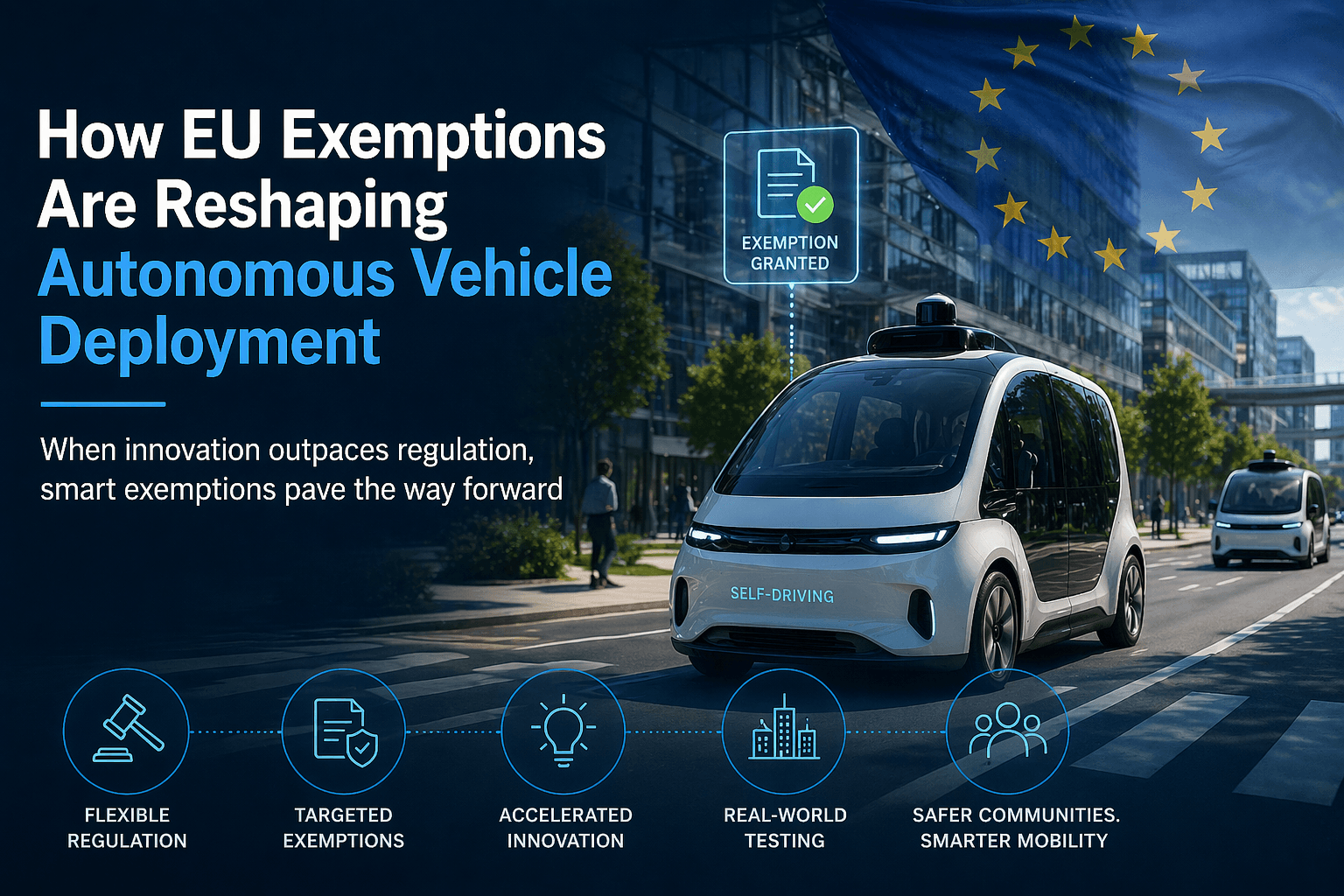
The European Union recognized early that breakthrough technologies often don't fit neatly into existing regulatory categories. Rather than force square pegs into round holes, the EU established guidelines for exemption procedures specifically for automated vehicle approval.
These exemptions serve a crucial function: they allow innovative vehicle technologies to be deployed even when they don't fully align with existing regulations. But this isn't regulatory chaos – it's structured flexibility designed to balance innovation with safety oversight.
The exemption framework works by:
- Coordinating national ad-hoc assessments to ensure consistent evaluation standards across EU member states
- Targeting automated vehicles that require compliance flexibility while maintaining safety benchmarks
- Providing regulatory pathways for technologies that exceed current regulatory assumptions
The Smart Balance: Safety Without Stagnation
What makes these exemption procedures particularly sophisticated is how they address a fundamental challenge in emerging technology regulation: how do you create rules for capabilities that don't yet exist?
Traditional automotive regulations assume human drivers with predictable reaction times, limited processing power, and consistent behavioral patterns. Autonomous systems operate under entirely different parameters:
- Processing speed: Machines can analyze sensor data in milliseconds
- Consistency: AI systems don't get tired, distracted, or emotional
- Sensor capabilities: Modern autonomous vehicles can "see" in conditions where humans cannot
The EU exemption procedures acknowledge that some safety innovations might actually exceed existing regulatory requirements rather than fall short of them. A Level 4 autonomous vehicle that can safely navigate complex scenarios might need exemptions not because it's less safe, but because its capabilities don't map to human-centric regulations.
Coordinated Assessment: Making Exemptions Work
The genius of the EU approach lies in its coordination mechanism. Rather than leaving each member state to create ad-hoc processes, the guidelines standardize how exemptions are evaluated and granted. This prevents a fragmented regulatory landscape where an autonomous vehicle approved in Germany might face entirely different requirements in France.
The coordinated assessment process ensures that:
- Safety standards remain consistent across the EU market
- Innovation timelines are predictable for manufacturers
- Regulatory learning is shared between member states
- Market access is streamlined for qualified technologies
Looking Ahead: Regulatory Evolution in Real Time
The combination of UN ECE global frameworks and EU exemption procedures represents something new in regulatory evolution: standards that can adapt in real time to technological advancement. Rather than waiting years for regulatory updates, this system allows innovation to proceed under structured oversight.
This approach has implications beyond Europe. As other regions grapple with similar challenges in autonomous vehicle regulation, the EU's exemption model provides a template for balancing innovation with safety oversight.
Conclusion
The future of autonomous vehicles won't be determined solely by technological capability – regulatory frameworks that can evolve with innovation will be equally crucial. The UN ECE has provided the global foundation with their comprehensive regulatory framework, while the EU's exemption procedures offer the flexibility needed for breakthrough technologies to reach consumers safely.
This isn't about lowering safety standards; it's about creating regulatory pathways sophisticated enough to evaluate technologies that exceed traditional assumptions about vehicle capability. As autonomous vehicles become increasingly capable, the regulatory frameworks that guide their deployment must be equally sophisticated.
The road ahead requires both global coordination and local flexibility – exactly what this regulatory partnership delivers.
The intersection of innovation and regulation has never been more critical to the future of transportation