
How Saphira AI Automates Safety Case Generation for Robots, Cars, and Beyond
As autonomous systems become more advanced—from mobile robots in warehouses to driverless vehicles on public roads—ensuring their safety and compliance with evolving regulations is not optional. Safety cases, which document the evidence that a system is acceptably safe, are required for certifications like ISO 26262, ISO 10218, CE Marking, and UL approvals. Traditionally, preparing these safety cases is a manual, time-consuming, and expertise-heavy process. Saphira AI is changing that.
Saphira enables developers of autonomous systems to automatically generate complete, audit-ready safety cases that align with industry standards and regulatory frameworks. By integrating hazard analysis, validation planning, and documentation into a unified platform, Saphira helps teams build safety cases faster, more accurately, and with full traceability.
Today, Saphira supports both functional safety and cybersecurity, generating a unified safety and security case from a single source of truth.
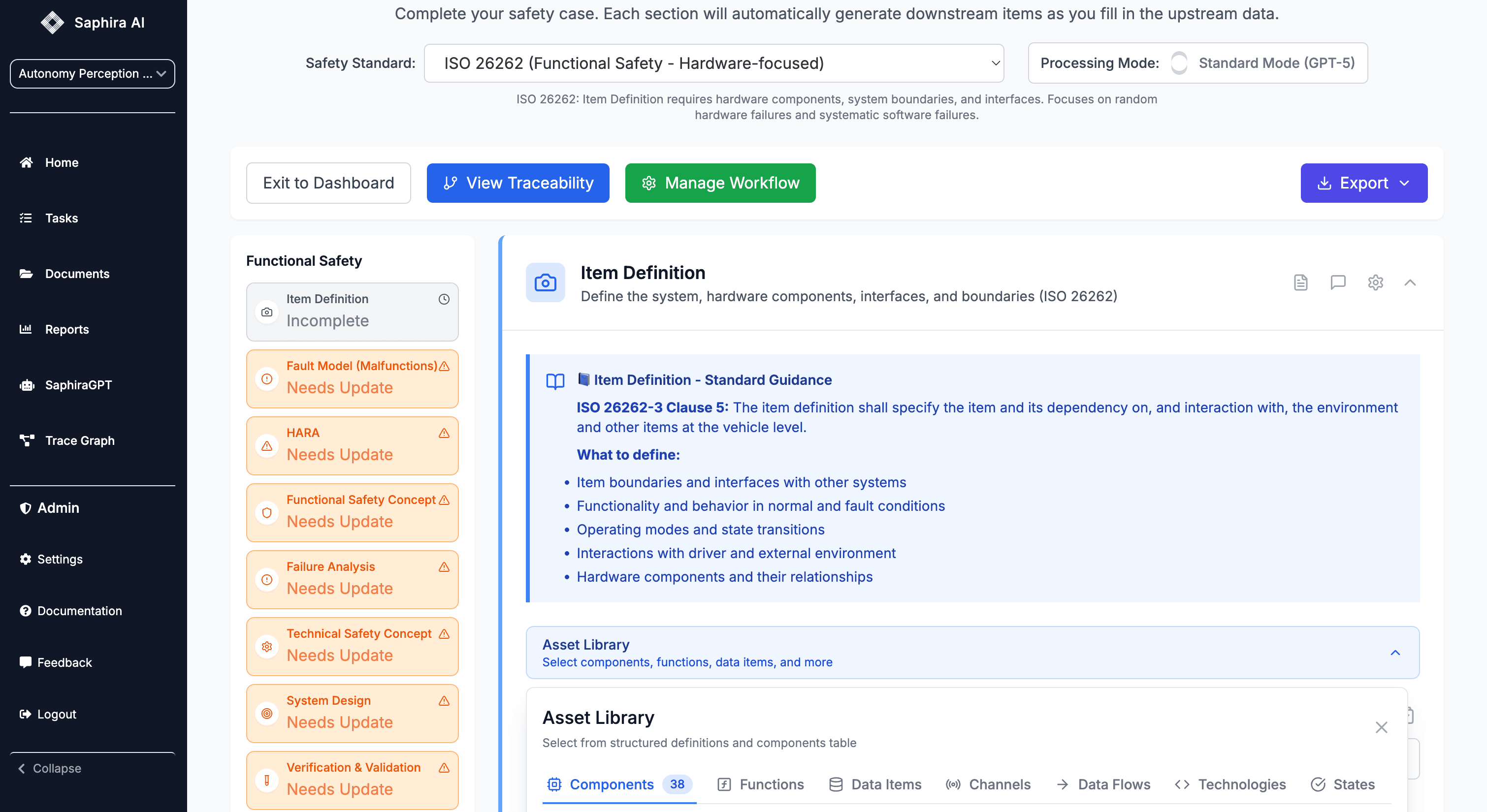
An automatically generated end-to-end safety and security case in Saphira, spanning ISO 26262 and ISO 21434 from Item Definition through audit-ready documentation.
Automated Safety Case Generation from Day One
Saphira begins with your system's risk assessment—either imported or built in-platform. From there, it automatically infers hazards, generates safety and cybersecurity goals, identifies applicable standards (e.g., ISO 26262, ISO 21434), and builds the initial safety case structure automatically. These goals are then traced to safety requirements and control measures, forming the core structure of the safety case. Instead of relying on spreadsheets or fragmented documents, users get a complete, standards-compliant structure generated in minutes.
The platform's AI engine understands the relationships between different safety standards and can automatically map your system's characteristics to the relevant regulatory requirements. Whether you're building a collaborative robot arm, an autonomous mobile robot, or a self-driving vehicle, Saphira identifies the applicable standards and generates the appropriate safety case structure.
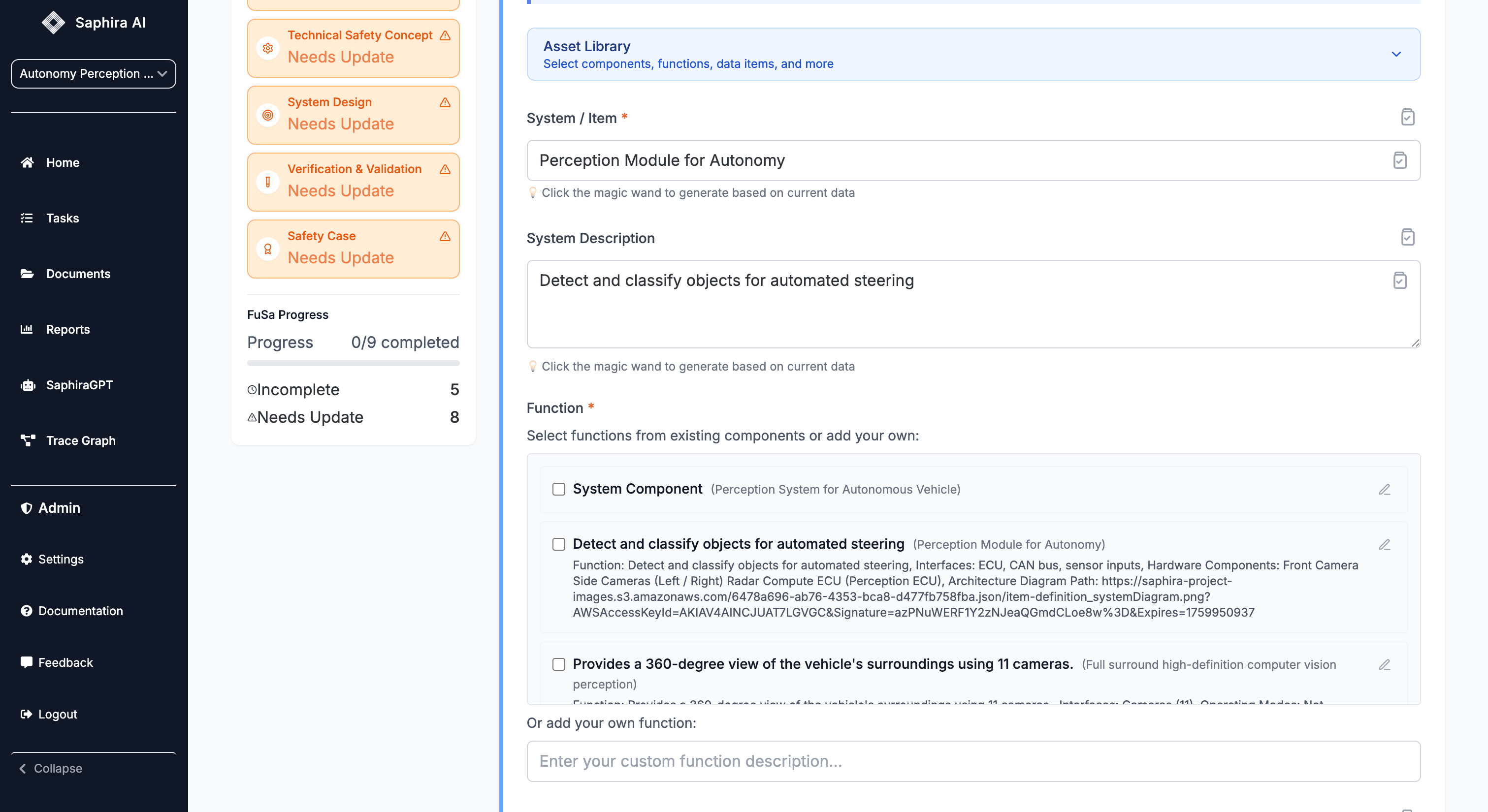
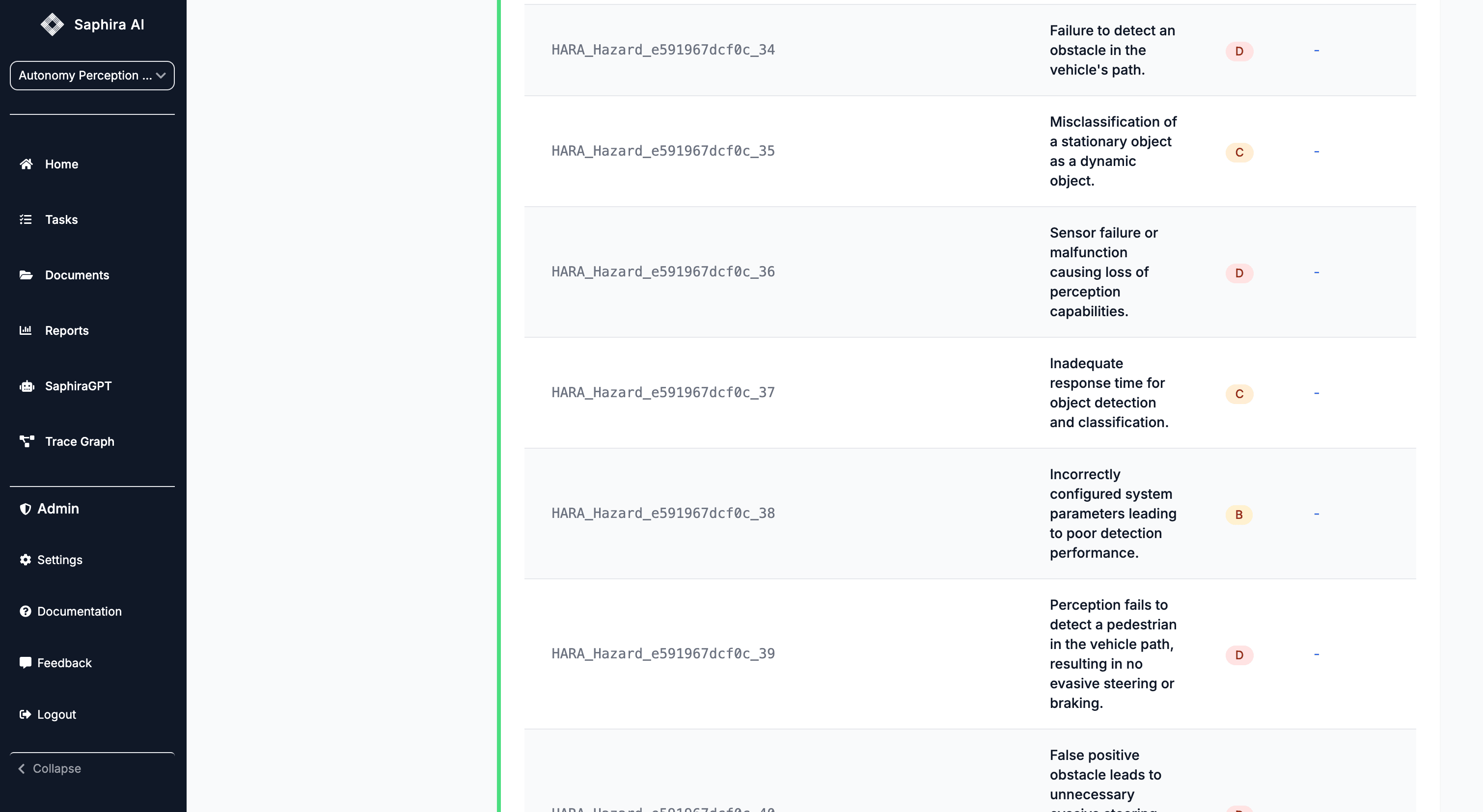
Starting from an Item Definition, Saphira automatically derives hazards, safety goals, and applicable standards—eliminating weeks of manual setup.
Traceability from Hazards to Evidence
One of the biggest challenges in building safety cases is proving that risks have been identified, mitigated, and validated. Saphira creates a traceability matrix that links hazards to safety goals, functions, test cases, and regulatory clauses. Each requirement and control is tied to supporting evidence—whether that's test reports, technical documentation, or validation plans—so that reviewers can see exactly how each safety argument is supported.
This traceability is crucial for certification audits, where regulators need to verify that every safety requirement has been properly addressed. Saphira's automated traceability ensures that no requirements fall through the cracks and that all safety arguments are properly supported with evidence.
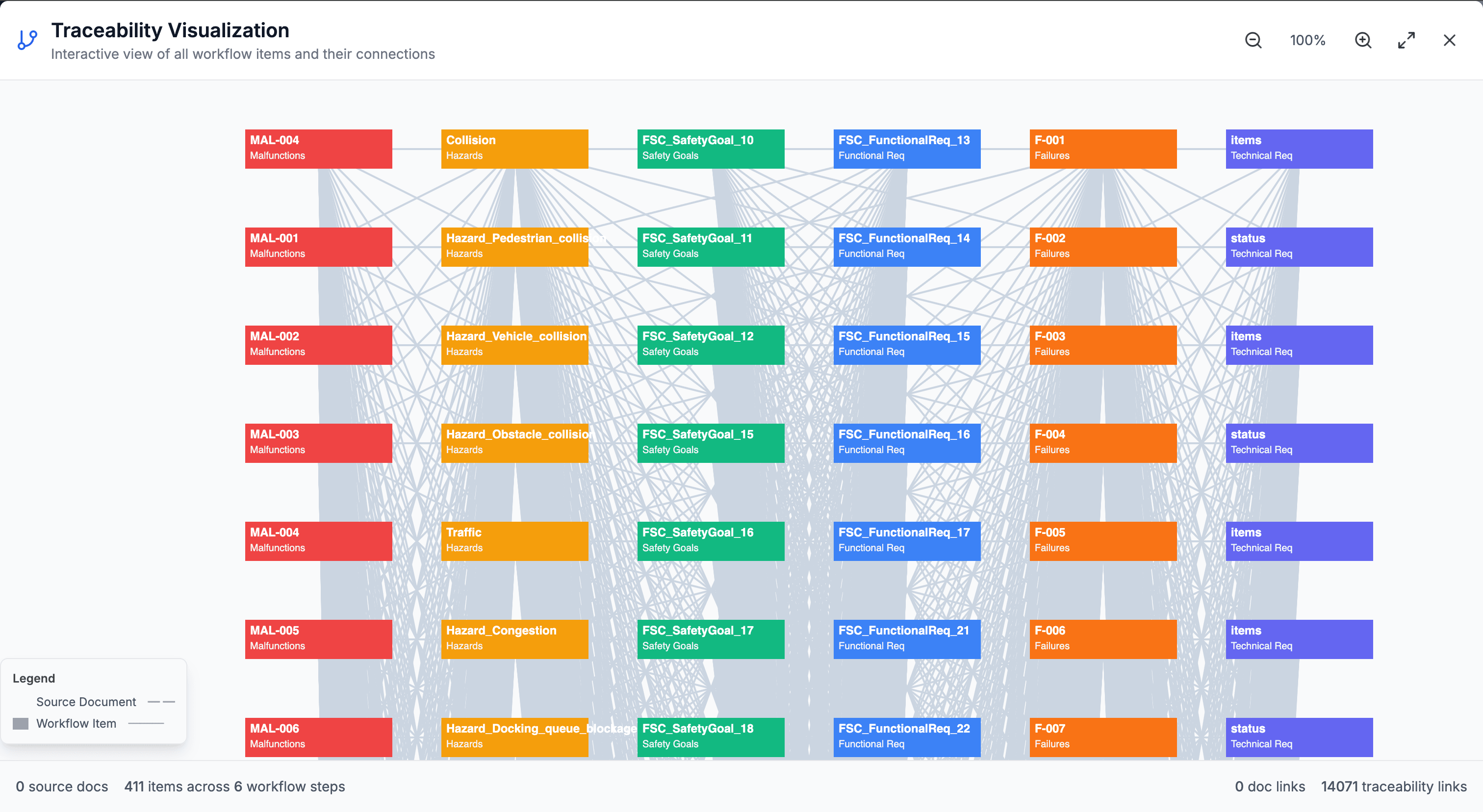
Live traceability from hazards through requirements, tests, and evidence—automatically maintained as the system evolves.
Integrated Cybersecurity & TARA (ISO 21434)
In addition to functional safety, Saphira now supports cybersecurity safety cases aligned with ISO 21434. Teams can generate Threat Analyses and Risk Assessments (TARAs), derive cybersecurity goals and requirements, and link them directly into the same safety case structure—ensuring consistency between safety and security arguments.
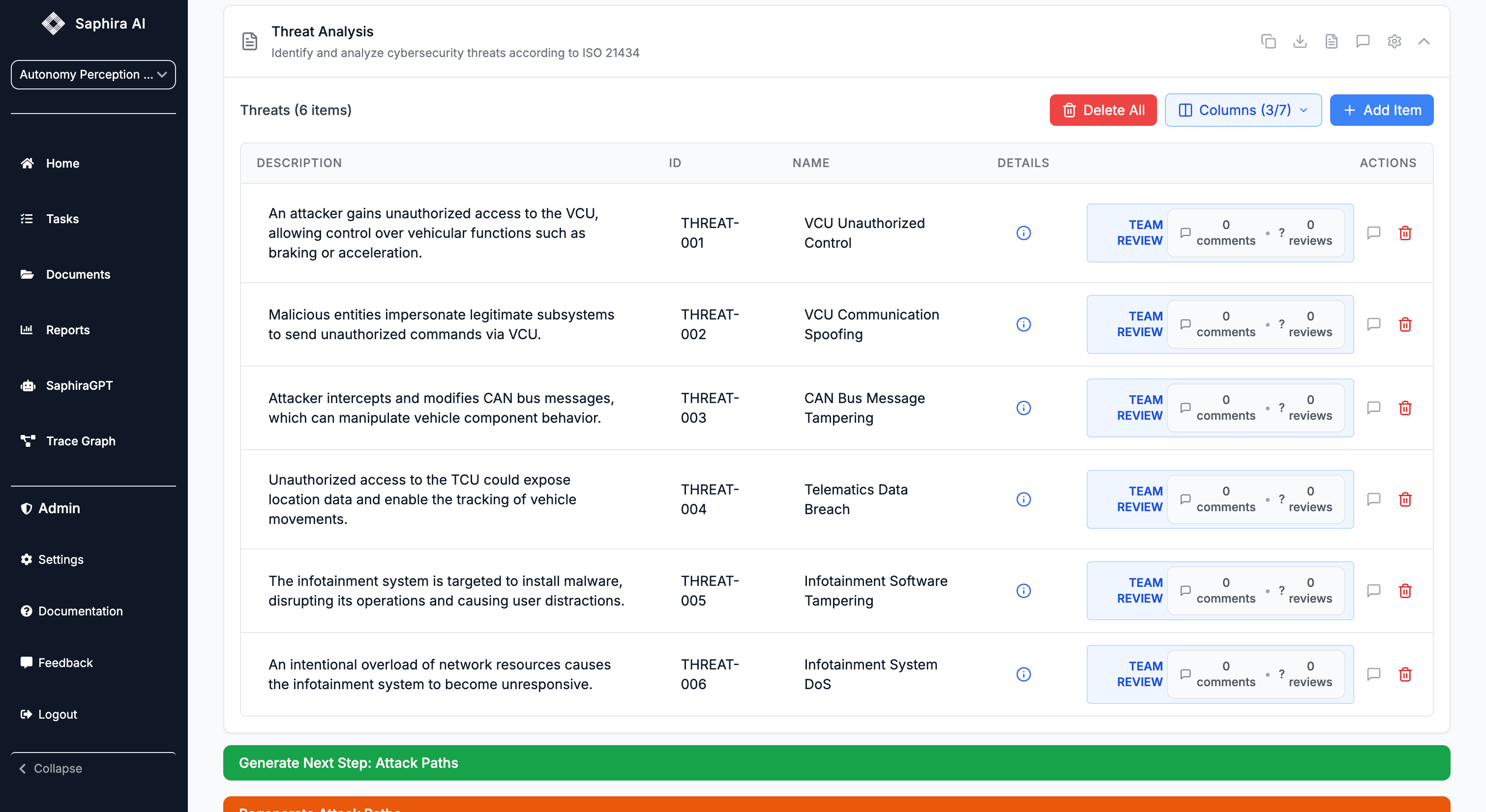
ISO 21434-aligned Threat Analysis and Risk Assessment (TARA) generated directly from system assets and architecture.
Integrating Test Plans and Validation Evidence
With autonomous systems, theoretical safety is not enough—real-world performance must be validated. Saphira allows users to generate test plans for every safety function, aligned with the applicable standard (e.g., ISO 26262 for cars or ISO 10218 for robots). These test plans include specific test cases, acceptance criteria, and even executable code templates for automated verification. All test results can be uploaded and directly linked to the relevant parts of the safety case, streamlining evidence collection and improving confidence in safety outcomes.
The platform can generate test cases that cover:
- Functional safety testing for safety-critical functions
- Environmental testing for various operating conditions
- Fault injection testing to verify system behavior under failure conditions
- Integration testing to ensure all components work together safely
Test results, reports, and logs can be uploaded and immediately reflected in the safety case.
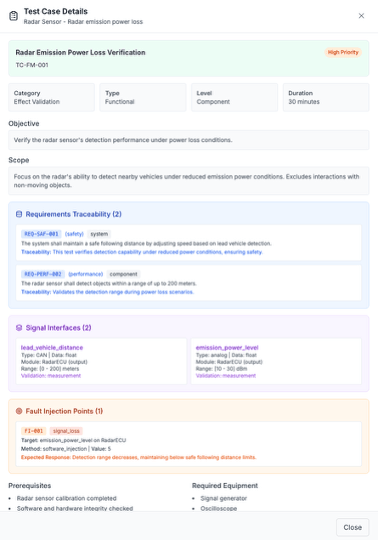
Automatically generated test plans linked directly to safety and cybersecurity requirements.
Architecture & Safety Diagrams from System Artifacts
Saphira can now automatically generate system, safety, and security diagrams directly from project artifacts. These diagrams stay in sync with the safety case and can be embedded directly into exported documentation.
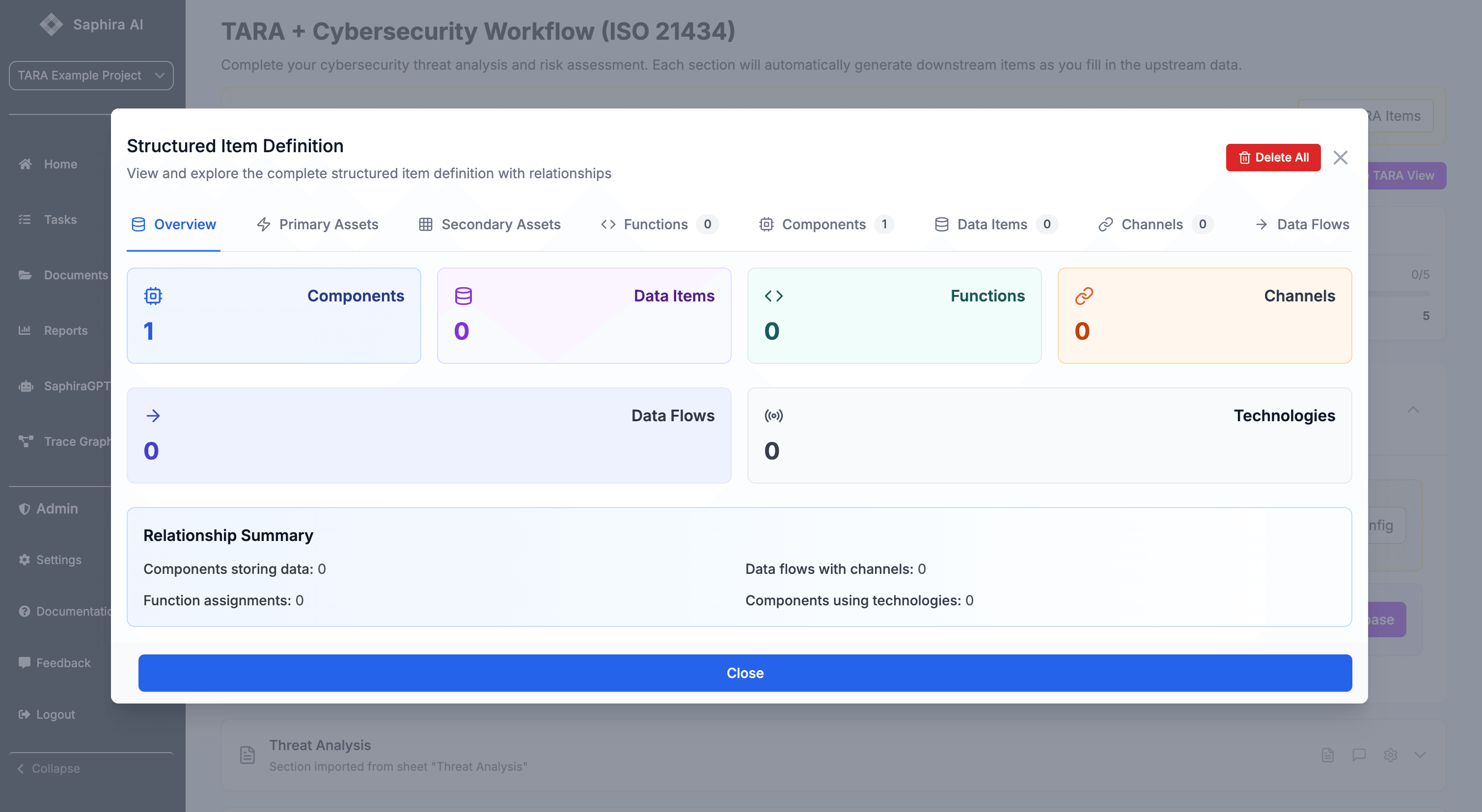
System and safety architecture diagrams automatically generated from underlying artifacts using Mermaid.
Multi-Standard Support for Complex Systems
Many autonomous systems must comply with more than one standard. For example, a robotic delivery vehicle might fall under ISO 26262 for functional safety, ISO 10218 for robotics safety, and multiple CE Mark directives. Saphira supports multi-standard safety cases by mapping requirements and safety goals to multiple regulatory frameworks at once. The platform highlights overlapping requirements, avoids redundancy, and ensures complete compliance coverage across standards.
This multi-standard approach is particularly valuable for complex autonomous systems that operate in multiple environments or serve multiple purposes. Saphira's AI can identify conflicts between standards and suggest harmonized approaches that satisfy all applicable requirements.
Real-Time Guidance with Standards Chatbot
SaphiraGPT, the platform's embedded chatbot, helps users ask complex regulatory questions and get cited, standards-based answers in seconds. This is particularly valuable when building safety cases that must reference specific clauses or justify decisions based on regulatory language. Whether you're asking how to handle emergency stops or how your system aligns with Part 4 of ISO 26262, SaphiraGPT delivers confident, traceable responses that can be cited directly in your safety documentation.
The chatbot can help with questions like:
- "What are the safety requirements for collaborative robots under ISO 10218-2?"
- "How do I demonstrate SIL 2 compliance for my autonomous vehicle?"
- "What test procedures are required for emergency stop functionality?"
- "How do I document software safety requirements for AI-based decision making?"
Export-Ready Safety Case Documentation
Once your safety case is complete, Saphira exports it in formats accepted by regulators and notified bodies. This includes CE Mark Technical Files, UL certification packages, detailed validation reports, traceability matrices, and evidence summaries. You can also generate gap analyses that highlight missing elements or incomplete validation, giving teams a clear roadmap to readiness.
The platform supports multiple export formats:
- PDF reports for regulatory submission
- Word documents for further editing and customization
- Excel spreadsheets for traceability matrices
- XML/JSON for integration with other tools
- Custom templates for specific certification bodies
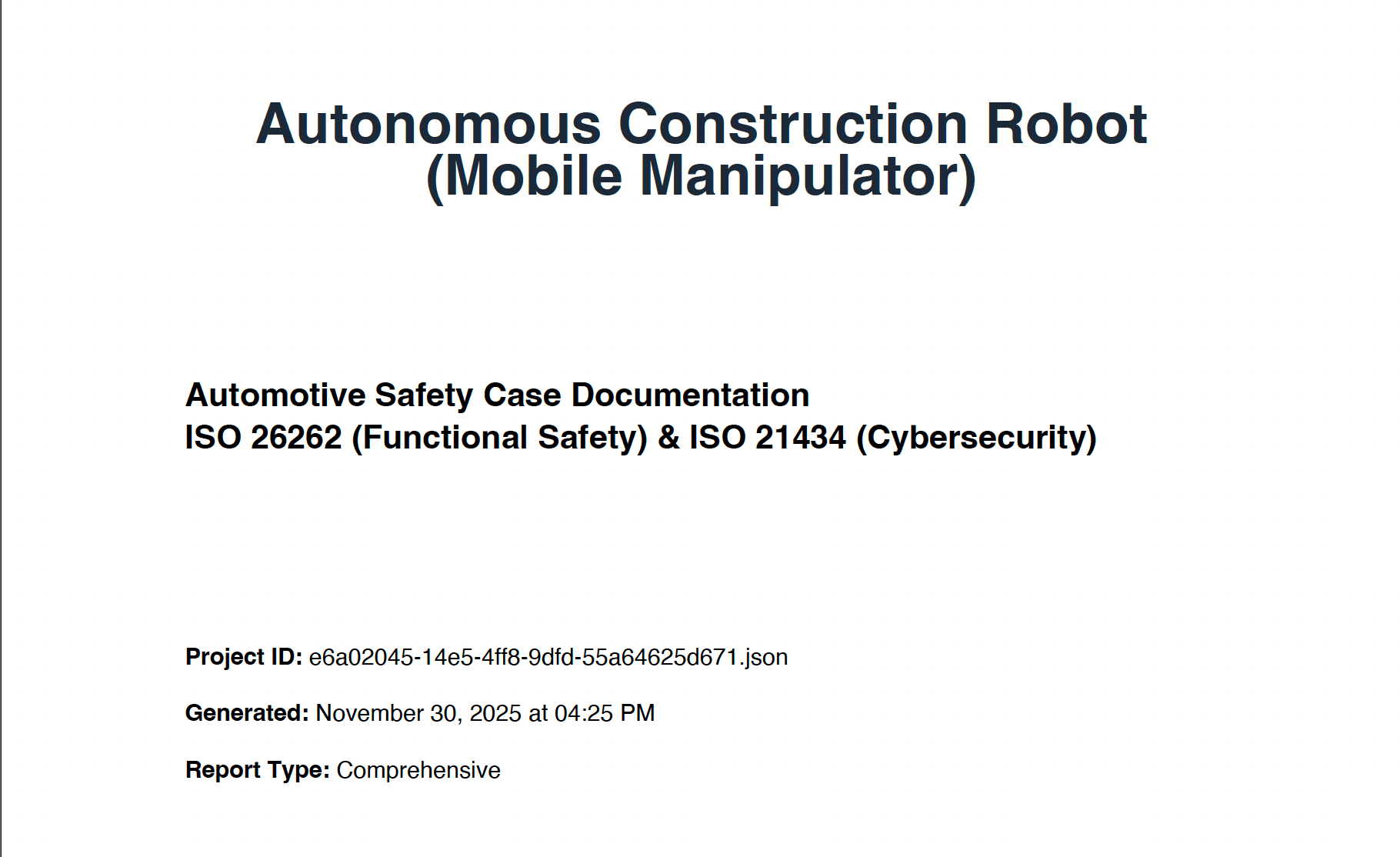
One-click export of audit-ready safety and security case documentation in regulator-friendly formats.
Accelerating Certification Without Compromising Safety
By automating safety case generation and linking every requirement to validation and evidence, Saphira AI eliminates the bottlenecks that slow down autonomous system certification. Teams can iterate quickly, reduce manual effort, and respond to regulatory changes without starting from scratch. Most importantly, they can prove—clearly and confidently—that their systems are safe for deployment.
The platform's automation capabilities can reduce the time required to prepare a complete safety case by 60-80%, while improving accuracy and completeness. This acceleration is critical in fast-moving industries where time-to-market can make the difference between success and failure.
Key Benefits for Autonomous System Developers
Reduced Time to Certification
- Automated safety case generation saves months of manual work
- Real-time validation ensures issues are caught early
- Streamlined documentation processes accelerate review cycles
Improved Compliance Confidence
- Multi-standard support ensures comprehensive coverage
- Automated traceability prevents missing requirements
- AI-powered guidance reduces interpretation errors
Enhanced Collaboration
- Centralized platform enables team collaboration
- Real-time updates keep all stakeholders informed
- Version control ensures audit trail integrity
Cost Reduction
- Reduced reliance on external consultants
- Faster certification cycles lower development costs
- Automated processes reduce manual errors and rework
Real-World Applications
Saphira's AI-powered safety case generation is already helping teams across the autonomous systems industry:
- Manufacturing robots achieving ISO 10218 compliance in weeks instead of months
- Autonomous vehicles streamlining ISO 26262 safety case preparation
- Mobile robots navigating complex multi-standard requirements
- Collaborative robots ensuring human-robot interaction safety
- AI-powered systems documenting software safety requirements
Getting Started with AI-Powered Safety Cases
As the complexity of autonomous systems continues to grow, safety and speed are no longer trade-offs. With Saphira, you can have both.
Ready to accelerate your autonomous system certification? Book a demo with Saphira to see how AI can transform your safety case preparation process.
Whether you're building the next generation of industrial robots, autonomous vehicles, or AI-powered systems, Saphira's AI platform can help you achieve certification faster while ensuring your systems are truly safe for deployment.