
One of the least discussed bottlenecks in modern robotics, automotive, aerospace, and industrial AI is not compute.
It is qualified engineering judgment.
As autonomy systems become more complex, organizations increasingly struggle to find engineers who can:
- perform a credible HARA or FMEA
- build a defensible safety case
- reason across ISO 26262, ISO 21434, IEC 61508, UL 4600, or ISO 13849
- understand system interactions across hardware, software, and operations
- identify where assumptions silently break under change
The shortage is especially acute in:
- steering and braking systems
- ADAS and autonomous driving
- industrial robotics
- medical robotics
- aerospace autonomy
- safety-critical embedded systems
The industry often talks about “AI replacing engineers.”
In practice, the immediate reality is almost the opposite: experienced safety engineers are becoming increasingly leveraged and difficult to scale.
This creates an important question:
How do we preserve, operationalize, and extend scarce engineering expertise without pretending to automate accountability itself?
We believe the answer is emerging in the form of Qualified Safety Agents.
The Real Problem Is Not Document Generation
Most current AI discussions around safety engineering focus on:
- auto-generating documents
- filling templates
- producing requirements
- accelerating compliance workflows
Those capabilities matter.
But they are not the core long-term challenge.
The deeper challenge is preserving and operationalizing engineering reasoning.
An experienced safety engineer does not simply fill out an FMEA worksheet.
They carry:
- historical failure knowledge
- system intuition
- architectural pattern recognition
- regulatory interpretation experience
- understanding of prior incidents
- domain-specific heuristics
- awareness of organizational blind spots
Much of this knowledge is:
- fragmented
- tribal
- inconsistently documented
- trapped inside individuals and organizations
When experienced engineers leave, a significant portion of that reasoning often leaves with them.
This is becoming unsustainable as systems grow more complex and iteration cycles accelerate.
What Is a Qualified Safety Agent?
A Qualified Safety Agent is not an autonomous sign-off system.
It is not an “AI safety engineer.”
And it is not a replacement for accountable human review.
Instead, a Qualified Safety Agent is an engineering reasoning system that:
- captures structured safety knowledge
- preserves traceable engineering logic
- understands domain-specific context
- maintains relationships across artifacts
- assists engineers inside existing workflows
- continuously updates reasoning under change
- keeps human engineers in control
Importantly: the agent is qualified through traceability, grounding, evidence linkage, and constrained operational scope.
Not through marketing claims of “general intelligence.”
Domain-Specific Safety Matters
Safety engineering is deeply contextual.
A steering system safety analysis differs fundamentally from:
- a perception stack analysis
- a warehouse AMR analysis
- a surgical robotics assessment
- a battery management system review
The hazards, assumptions, architectures, and standards differ substantially.
This is why generalized AI assistants often fail in serious engineering contexts.
They lack:
- domain structure
- architectural understanding
- standards context
- operational constraints
- traceable reasoning
A credible safety agent for ADAS systems must understand concepts like:
- controllability
- ASIL decomposition
- perception uncertainty
- sensor fusion assumptions
- driver monitoring dependencies
- operational design domains
- fail-operational architectures
A credible industrial robotics agent must reason differently:
- safeguarding
- SRP/CS architectures
- stop categories
- human interaction zones
- diagnostic coverage
- lockout/tagout
- functional stop behavior
The future will likely involve families of domain-specific safety agents:
- steering systems
- autonomous trucking
- humanoid robotics
- industrial automation
- aerospace systems
- medical robotics
- defense autonomy
Each built upon shared infrastructure, but specialized through domain reasoning models and knowledge graphs.
The Missing Layer: Structured Safety Knowledge
One of the biggest opportunities in the industry today is building structured, machine-readable safety knowledge infrastructure.
Today, much engineering knowledge remains locked inside:
- PDFs
- standards documents
- spreadsheets
- disconnected requirements systems
- internal wikis
- archived audits
- meeting notes
- expert memory
This makes reasoning brittle and difficult to scale.
A Qualified Safety Agent requires:
- standards structured into typed obligations
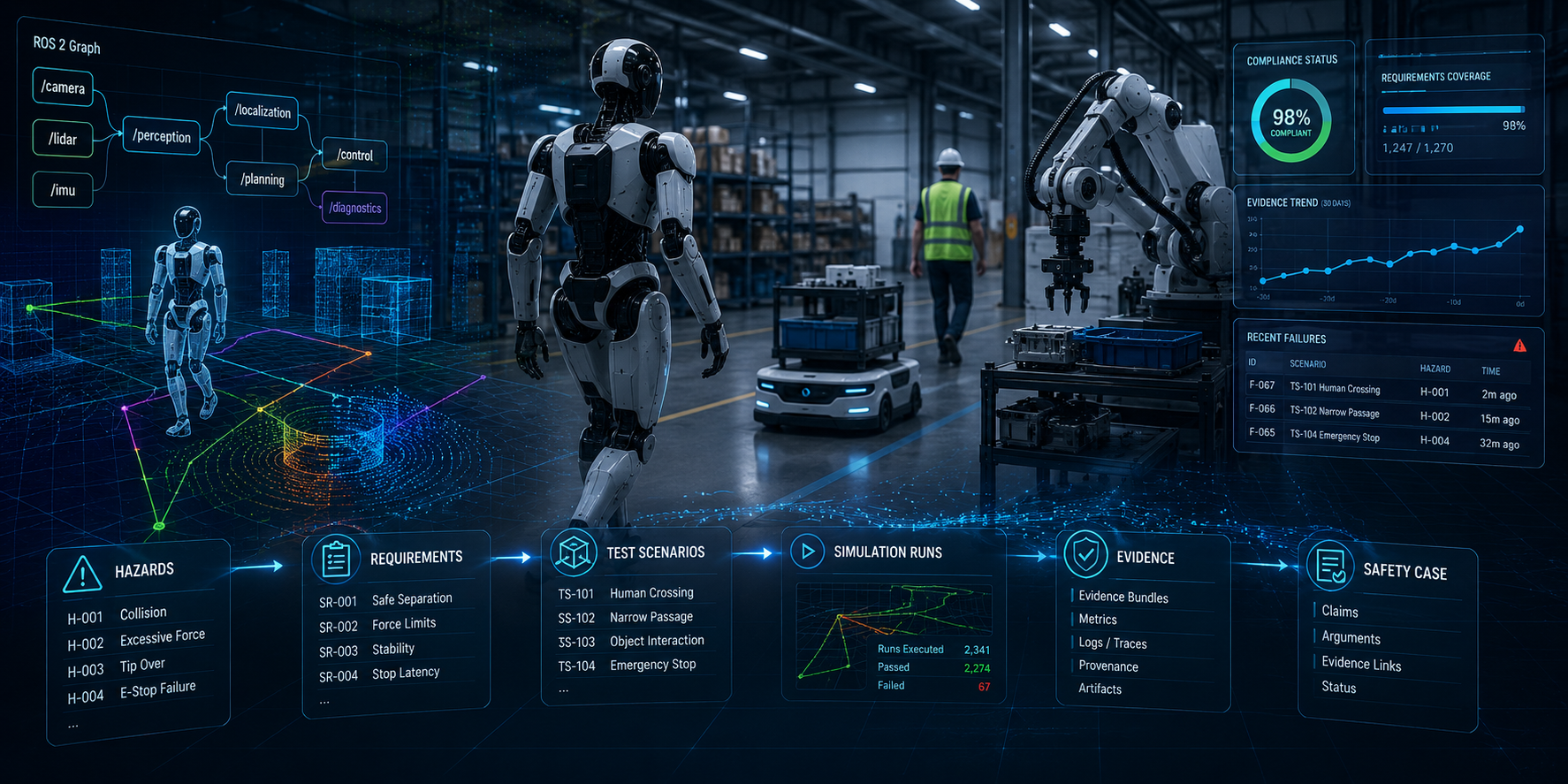
- traceable relationships between hazards, controls, tests, and evidence
- historical failure knowledge
- reusable architectural patterns
- operational assumptions
- simulation and validation context
- approval and review history
In other words: a continuously maintained assurance graph.
Why Open Knowledge Infrastructure Matters
Many organizations are beginning to recognize that safety engineering infrastructure should not remain entirely closed and fragmented.
Over the coming decade, we expect increasing investment in:
- open standards ontologies
- machine-readable regulations
- shared hazard taxonomies
- reusable assurance patterns
- interoperability layers
- open evaluation schemas
- safety evidence exchange formats
This does not eliminate proprietary differentiation.
But it creates a stronger foundation for:
- interoperability
- auditability
- portability
- regulator alignment
- ecosystem-scale tooling
The long-term winners in safety infrastructure are unlikely to be the organizations that merely generate documents fastest.
They will be the organizations that best structure, preserve, and operationalize engineering knowledge.
Human Engineers Remain Central
The role of Qualified Safety Agents is not to remove human accountability.
It is to increase engineering leverage.
A senior safety engineer should not spend most of their time:
- manually synchronizing traceability
- rebuilding stale matrices
- searching for evidence
- propagating changes across spreadsheets
- maintaining disconnected documents
Their time is too valuable.
Instead, they should focus on:
- reviewing critical reasoning
- evaluating tradeoffs
- validating assumptions
- exercising engineering judgment
- making deployment decisions
The system handles the propagation burden. The engineer remains accountable.
The Next Era of Safety Engineering
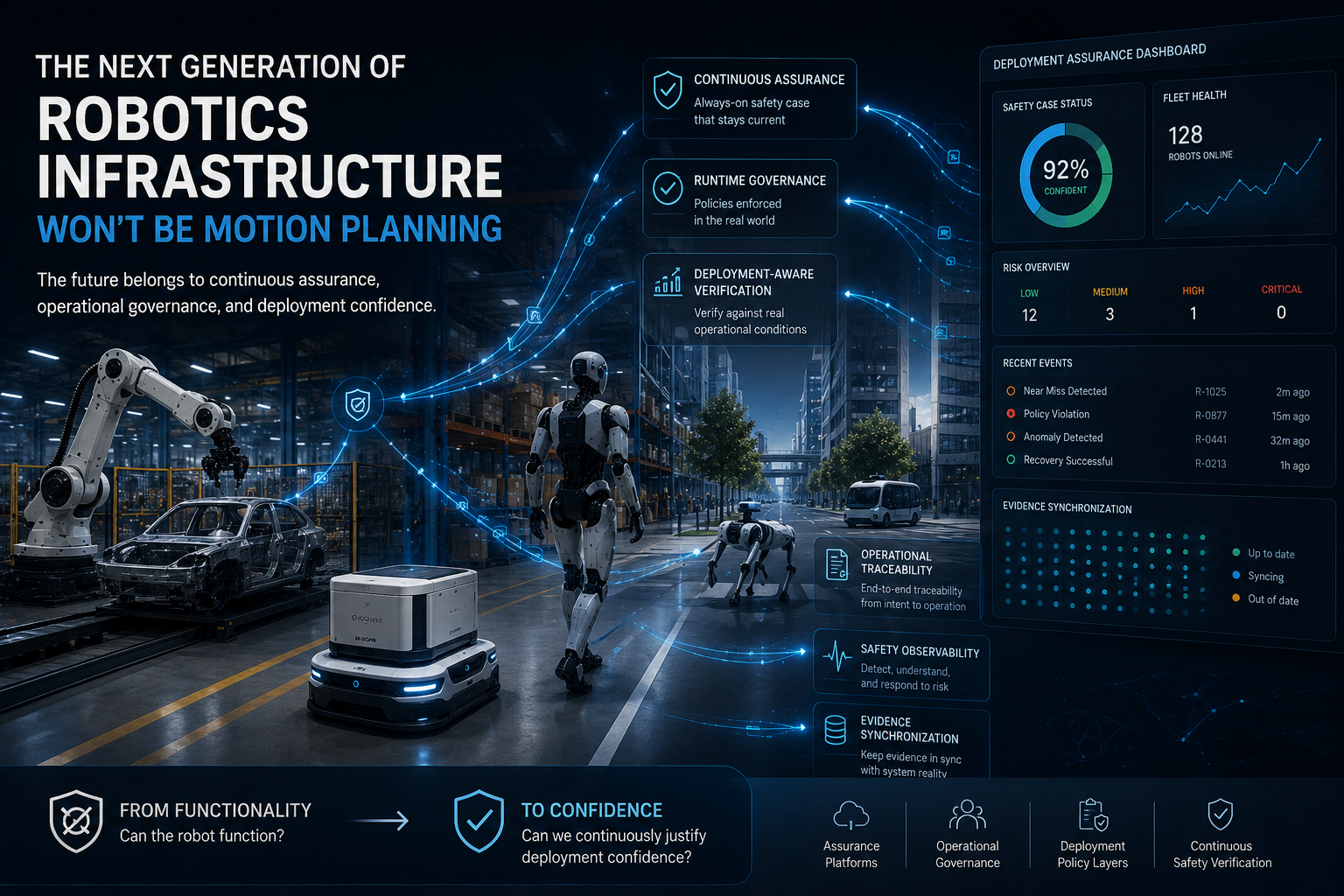
As embodied AI systems expand into the real world, the bottleneck increasingly becomes operational assurance.
Not just: “Can the system function?”
But: “Can organizations continuously maintain justified confidence in system behavior under ongoing change?”
That requires:
- continuously updated safety reasoning
- structured engineering knowledge
- domain-specialized assurance systems
- traceable decision infrastructure
- human-centered operational workflows
The future is not autonomous safety engineering.
The future is scalable engineering judgment.