
Introduction
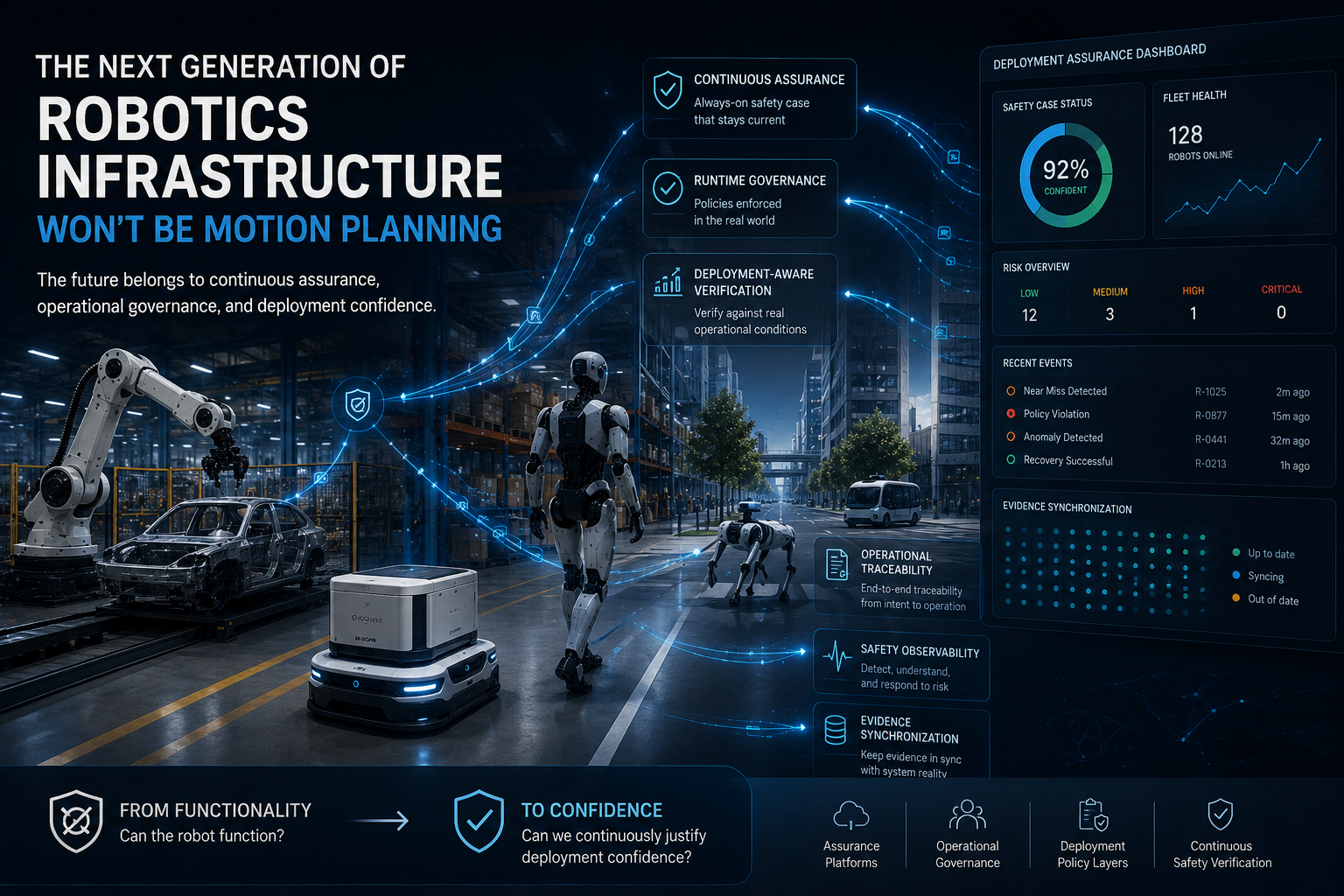
The robotics industry faces a critical challenge. Traditional safety documentation can't keep pace with rapid development cycles. Teams run thousands of simulation hours to validate their systems. Yet most of this valuable evidence remains disconnected from formal safety cases and regulatory documentation.
A new approach is emerging. This transforms simulation from isolated testing into the backbone of continuous safety assurance. This "living safety evidence" paradigm creates automated pipelines. Every simulation run directly updates formal safety arguments. This keeps certification documentation current with actual system state.
The Traditional Safety Documentation Problem
Current robotics safety processes treat simulation results and formal safety documentation as separate worlds. Teams typically follow these steps:
- Run extensive simulation campaigns to validate robot behaviors
- Manually extract key findings and metrics from simulation outputs
- Update safety documentation through separate, time-consuming processes
- Struggle to maintain traceability between specific hazards and their simulation-based evidence
This disconnect becomes problematic for human-adjacent robots like assistive devices and humanoids. Safety standards like ISO 13482 require continuous evidence. This evidence must show that protective measures remain effective throughout development.
The result? Safety documentation that's often months behind actual system capabilities. This makes it difficult to demonstrate compliance or identify emerging risks promptly.
Simulation as a Living Safety Engine
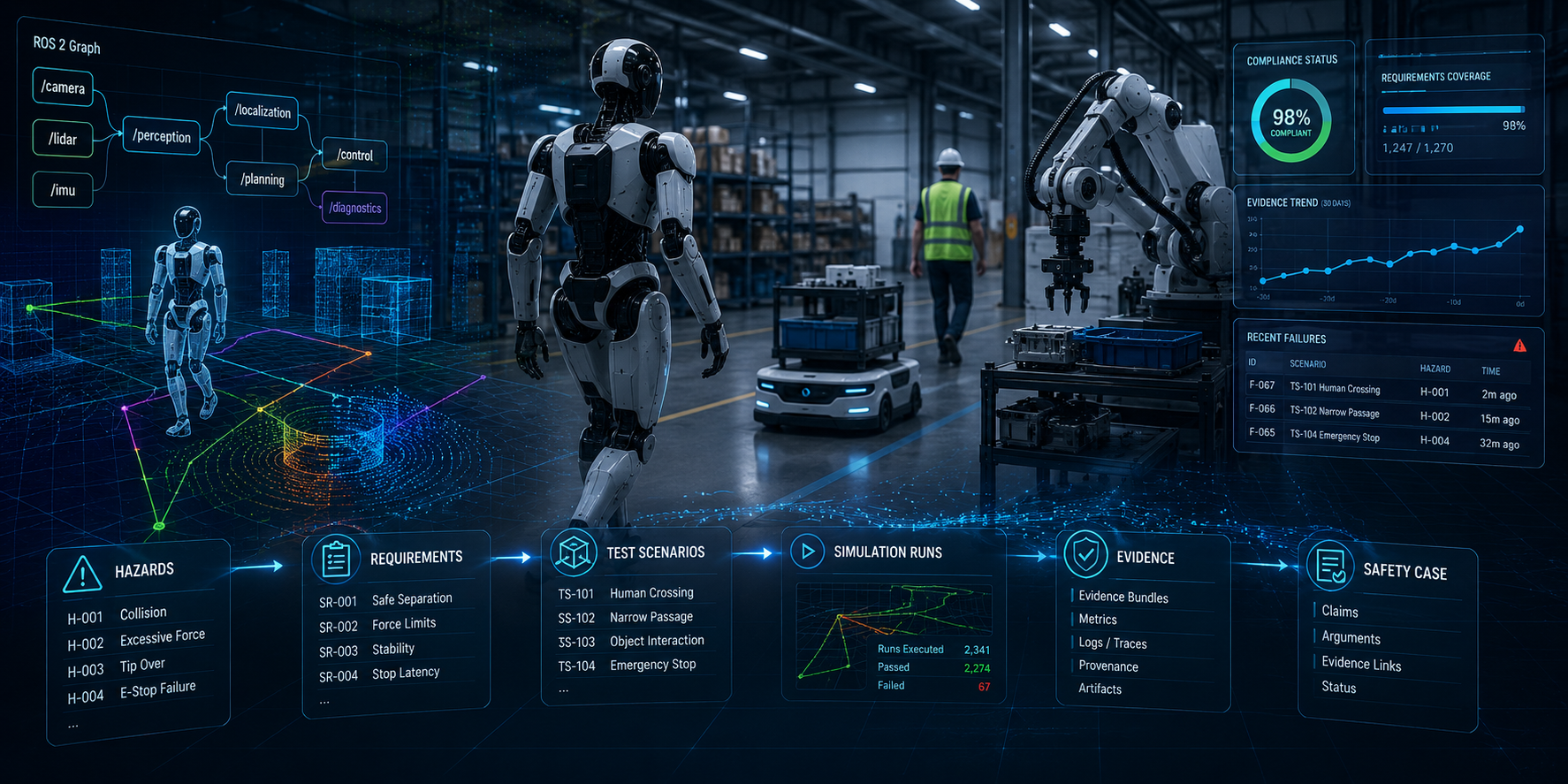
The solution treats simulation infrastructure as continuous safety evidence generation rather than just testing. This approach creates direct, automated links between these elements:
- Hazard definitions and the specific simulation scenarios that test them
- Safety requirements and the metrics that prove compliance
- Risk mitigations and the simulation evidence showing their effectiveness
- Safety claims and the reproducible test results that support them
When a simulation runner executes test scenarios, it automatically ingests results as structured evidence. This updates the formal safety posture in real-time. Failed tests immediately surface with actionable traces. Successful runs reinforce confidence in safety measures.
Key Technical Components
Immutable Evidence Chains
Every simulation run generates an immutable evidence bundle. This bundle contains:
- Complete provenance (software versions, random seeds, environmental parameters)
- Standardized metrics tied to specific safety requirements
- Failure classification using structured taxonomies
- Full traceability from hazard analysis through test execution to results
Automated Failure Detection
The system automatically classifies simulation failures into these categories:
- Physical violations: collision, excessive force, tip-over events
- Safety system failures: stop latency, e-stop malfunction
- Perception failures: missed detections, false positives
- Planning failures: deadlock, unsafe trajectories
Each failure type maps directly to specific hazards and safety requirements. This enables immediate impact assessment.
Reproducible Test Environments
Simulation scenarios become versioned, reproducible test packages. These packages can be:
- Executed deterministically across different environments
- Parameterized for domain randomization and stress testing
- Shared between teams with guaranteed consistency
- Re-run automatically when system components change
Benefits for Human-Adjacent Robotics
This approach proves especially valuable for robots operating near humans. Safety standards demand rigorous evidence in these cases.
Continuous Compliance Monitoring
Critical humanoid safety metrics get continuously validated against thresholds. These include peak contact forces, collision distances, and stop latencies. When requirements change or new edge cases emerge, the system automatically re-evaluates all affected claims.
Rapid Certification Updates
Teams can generate certification-ready evidence packages instead of manually rebuilding safety documentation. These packages show exactly which safety arguments remain valid and which require additional testing.
Proactive Risk Detection
The system maintains direct links between simulation results and hazard analysis. Teams can identify when minor changes might compromise previously validated safety measures.
Implementation Architecture
A practical implementation requires three key components:
- Safety Evidence Platform: Manages the formal safety model (hazards, requirements, claims, assumptions) and maintains traceability relationships
- Simulation Execution Engine: Runs test scenarios with full provenance capture and standardized result reporting
- Integration Layer: Orchestrates the flow from safety intent through simulation execution to evidence ingestion
The integration uses standardized schemas for run manifests and result bundles. This makes it possible to support multiple simulation platforms while maintaining consistent evidence quality.
Real-World Impact
Teams using this approach report immediate benefits:
- Faster development cycles: Safety validation happens automatically rather than requiring separate documentation sprints
- Improved traceability: Every safety claim connects directly to specific test evidence with full provenance
- Reduced compliance risk: Safety documentation stays current with system evolution rather than lagging behind
- Better failure response: When issues arise, teams can quickly reproduce problems and verify fixes
The Path Forward
This living safety evidence paradigm represents a fundamental shift. It moves from treating safety as documentation burden to making it integral to development workflow. As robotics systems become more complex and human-adjacent applications proliferate, automated safety assurance becomes essential.
The key is starting with clear traceability. Define explicit links between hazards, requirements, and test scenarios before building automation around them. Teams that establish this foundation early will find themselves far ahead when facing tightening regulatory requirements and customer safety expectations.
Safety isn't just about compliance—it's about building trust through continuous, transparent validation.